 EN
EN
 AR
AR
 CS
CS
 NL
NL
 FR
FR
 DE
DE
 EL
EL
 HI
HI
 IT
IT
 JA
JA
 KO
KO
 PL
PL
 PT
PT
 RO
RO
 RU
RU
 ES
ES
 SV
SV
 TL
TL
 IW
IW
 ID
ID
 UK
UK
 VI
VI
 SQ
SQ
 HU
HU
 TH
TH
 TR
TR
 FA
FA
 AF
AF
 MS
MS
 BN
BN
 HA
HA
 LA
LA
 MY
MY
 KK
KK
 SI
SI
 TG
TG
 UZ
UZ
 KY
KY
 XH
XH
How to Choose a Commercial Cotton Candy Vending Machine: 7 Key Factors for B2B Buyers (2026 Guide)
By Sunzeerobot Product Team | 11 years building fully automatic cotton candy vending machines for 50+ countries
Choosing the right commercial cotton candy vending machine comes down to seven factors: capacity, power compatibility, payments, consumable costs, maintenance cycles, certifications, and supplier reliability. Skip one, and a cheap machine on paper becomes expensive to run. We learned that in 2015, when buyers came back with wrong voltage, missing certifications, undersized hoppers, and suppliers who vanished.
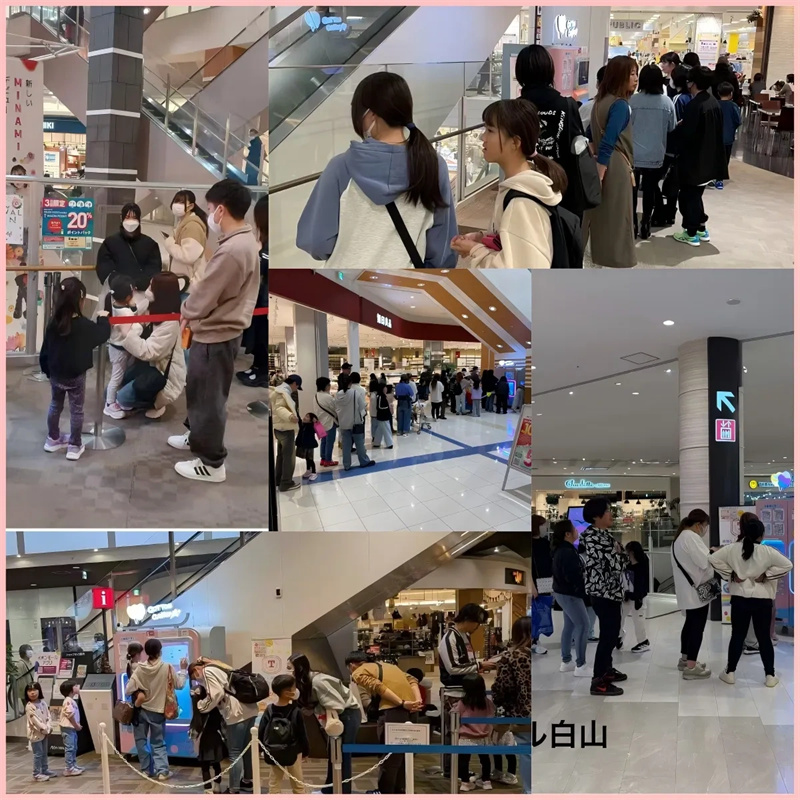
A commercial cotton candy vending machine deployed in a high-traffic U.S. mall location.
1. Production Capacity: Match Cycle Time to Foot Traffic
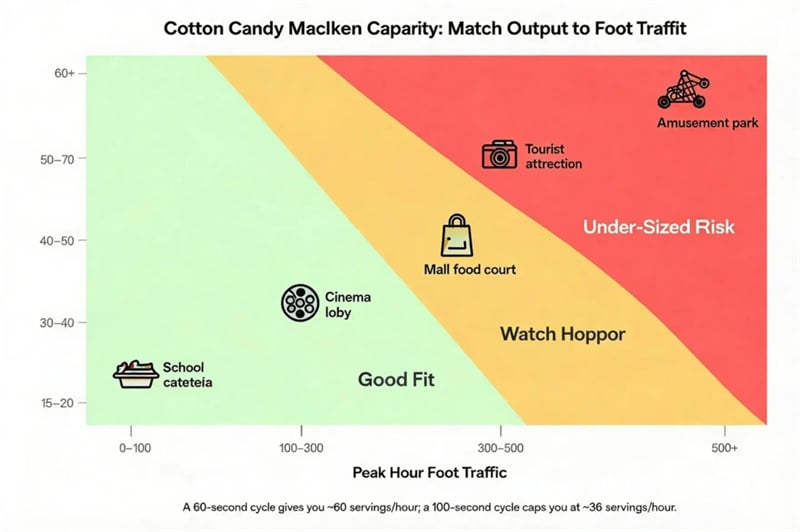
Match cycle time and hopper capacity to expected foot traffic to avoid lost sales.
First question: not "How fast does it make cotton candy?" but "How fast does your location need it?"
A typical machine makes one serving in 60–100 seconds. At 100 seconds, output caps at about 36 per hour; at 60 seconds, it hits 60 per hour. That gap decides whether you capture the rush or watch customers leave.
| Location Type | Peak Traffic | Output Needed | Cycle Time |
| School cafeteria | 50–100 people/hr | 15–20/hr | 90–100 sec |
| Cinema lobby | 150–300 people/hr | 30–40/hr | 75–90 sec |
| Mall food court | 200–400 people/hr | 40–50/hr | 60–75 sec |
| Tourist attraction | 400–800 people/hr | 50–70/hr | 50–60 sec |
| Amusement park | 500+ people/hr | 60+/hr | 45–60 sec |
Hopper size matters too. A 4×2 kg setup holds roughly 250–300 servings. We offer 4×2 kg and 6×2 kg configurations; for more than 300 daily potential customers, the 6×2 kg setup is safer. Our own fleet moved to larger tanks after the first summer.
2. Power Compatibility: Get the Right Voltage Package
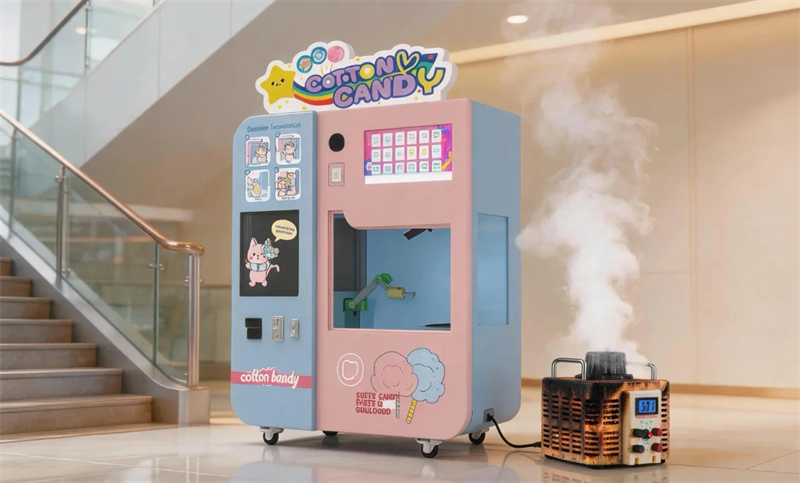
External transformers add mounting, compliance, and overheating risks—factory-configured voltage is safer.
Voltage is the most common reason a cotton candy machine fails in a new market. Buyers who need external transformers often struggle with mounting, local electrical compliance, and heat-related maintenance alarms. We have also seen 110V-only units shipped to the Gulf overheat and trip breakers on hot afternoons.
Each market has a different electrical fingerprint:
• **USA / Canada:** 110–120V, 60 Hz, NEMA 5-15 or 5-20 plugs
• **Japan:** 100V, 50 Hz east / 60 Hz west, PSE diamond mark required
• **UAE / Gulf:** 220–240V, 50 Hz, BS 1363 (G-type) plugs, high ambient temperatures
A B2B-grade machine should arrive ready for the local socket. We configure each unit at the factory with the right voltage module, plug type, and safety approvals, so the same model can deploy in Tokyo, New York, or Dubai without an external transformer.
We run every machine through a 72-hour aging test in an environmental lab at 45°C / 70% RH before shipping. If a supplier cannot show a climate test report, that is a red flag.
For U.S. deployment details, see our commercial cotton candy vending machine page.
3. Payment Systems: Cash, Card, QR, NFC
Payment habits vary sharply. The U.S. still uses cash but card and mobile wallets are rising. Japan expects Suica, PayPay, and other cashless options. The UAE sees cards from tourists and QR wallets from locals.
A modern machine should support all four:
• Cash / coin
• Card reader with NFC (Apple Pay, Google Pay)
• QR code payment
• Mobile wallet integration
Back-end telemetry with real-time alerts on sales, inventory, and machine health cuts downtime. A jammed sugar path or empty hopper is cheaper to fix when caught early.
Real-world deployment data shows how payment setups affect ROI—see our applications page.
4. Raw Material & Consumable Costs
The cost per serving is the draw—but only if you calculate it correctly. The main consumables are sugar, paper sticks, and water.
A typical serving costs about $0.20 in sugar and stick, leaving a 95%–97% gross margin at a $4–$6 price.
Hidden variables:
• **Sugar grade:** 1.5–2.5 mm granulated sugar works best. A well-designed dispenser handles a wider range; a poor one clogs or burns.
• **Water quality:** Use purified water if possible. Tap water can work, but it may leave mineral deposits in the humidification module. An experienced manufacturer will provide a complete water-treatment solution.
• **Stick size:** Diameter is typically 10 mm, and length ranges from 200–300 mm. An experienced manufacturer can even print your custom logo on the sticks.
5. Maintenance Cycles: Cleaning, Downtime, and Spare Parts
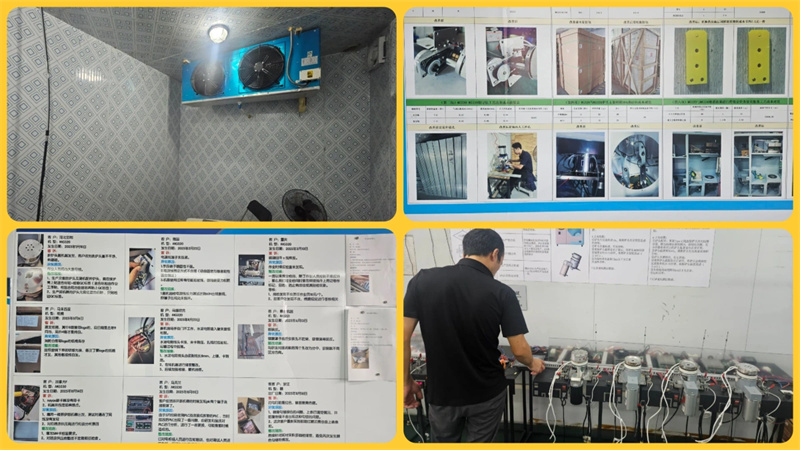
A 72-hour aging test in an environmental lab simulates real-world heat and humidity before shipping.
A cotton candy machine is automated food equipment. Sugar is sticky, heat caramelizes residue, and humidity makes sugar clump. Without easy cleaning, it jams, produces poor floss, or stops.
The six subsystems that need regular attention:
1. Sugar dispensing module
2. Robotic arm / shaping mechanism
3. Furnace head
4. Humidification system
5. Touchscreen and payment module
6. Stick delivery path
A professional manufacturer designs these subsystems for easy access and long maintenance-free operation, typically 3–7 days between checks. At our factory, every module runs through aging and inspection SOPs before final assembly. Our upgraded humidification module cut weekly cleaning stops by about 23% in our self-operated fleet.
Before you buy, ask: How long does daily cleaning take? Which parts wear out first? Where are spare parts stocked? How fast can a replacement reach you?
6. Certifications: CE, FDA, ETL, NAMA, and Local Standards
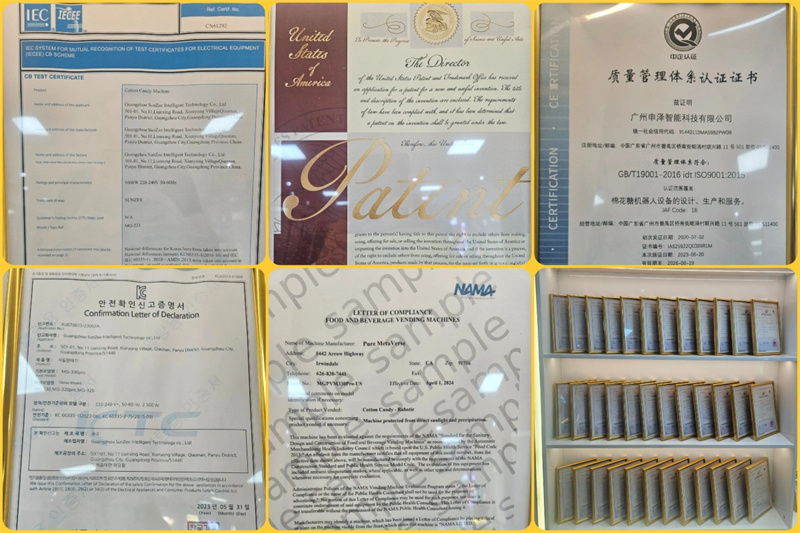
ETL, NAMA, CE, PSE, and ISO 9001 approvals support deployment in the U.S., Japan, UAE, and EU.
Certifications prove the machine was tested as a complete system and meets your target market's safety and food-contact rules.
| Market | Key Certifications | Why They Matter |
| USA / Canada | ETL, NAMA, FDA food-contact | Electrical + food safety |
| Japan | PSE diamond mark, food sanitation law | 100V + food approval |
| UAE / GCC | CE, Halal compliance, local electrical approval | Import + dietary rules |
| EU | CE, RoHS | Access + substance limits |
| Global | ISO 9001, CB | Quality + electrical safety |
We hold ETL, NAMA, CE, CB, CQC, PSE diamond mark, and ISO 9001.
One detail buyers miss: CE alone does not cover food-grade materials in every EU country. Some markets need extra documentation.
7. Supplier Evaluation: A Factory Audit Checklist
The spec sheet says what the machine should do. The audit says whether it will do it for five years.
We evaluate partners on four things:
1. **In-house R&D and production:** Do they design the machine or assemble trader parts?
2. **Quality system:** ISO 9001-certified process with module-level aging tests?
3. **Operational experience:** Do they run their own machines?
4. **After-sales infrastructure:** 24×7 support team and spare-parts logistics?
Practical checklist:
| Question | Good Answer |
| How long in cotton candy machines? | 8+ years focused on the category |
| Technical + service team? | 20+ dedicated staff |
| Own patents? | Yes, with verifiable numbers |
| Certifications for my markets? | ETL, NAMA, CE, PSE, ISO 9001 |
| Voltage configuration? | Factory-configured; no external transformer |
| Operate own machines? | Yes, with real deployment data |
| Spare-parts policy? | 24×7 support + international shipping covered |
Sunzeerobot has 70+ staff on social insurance, a 25+ person technical and service team, and over 80 patents covering core subsystems. We run our own machines in amusement parks and scenic areas for real-world validation.
In 2018, we launched our MG300 at the Canton Fair; CIFNews, a leading Chinese cross-border trade media outlet, covered the launch Source: https://www.cifnews.com/article/34487
Contact our team for a factory video tour and region-fit checklist.
Total Cost of Ownership: The Number That Actually Matters
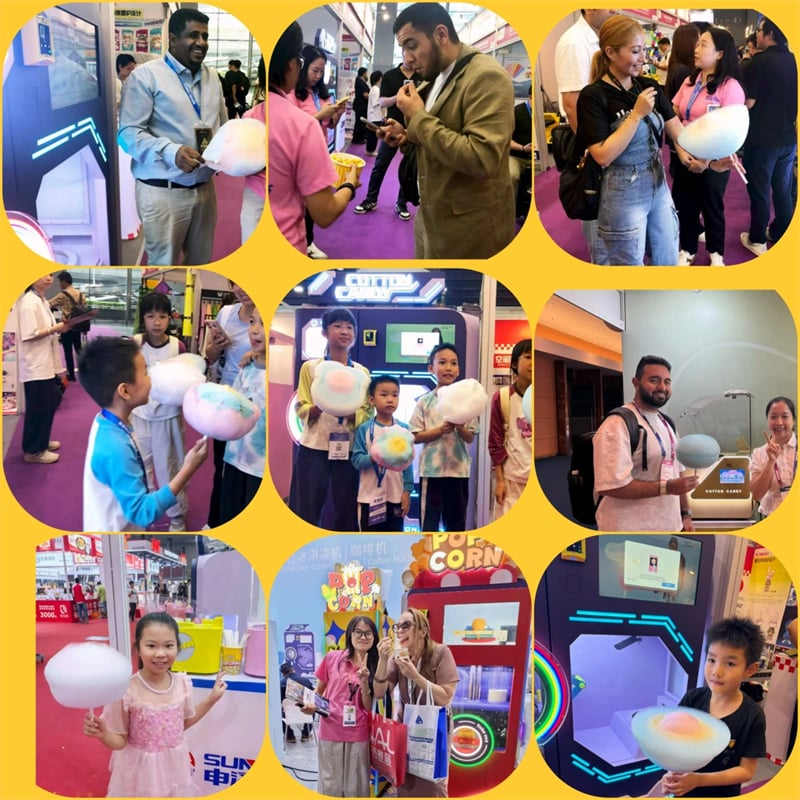
From malls to amusement parks, cotton candy vending machines fit a wide range of B2B locations.
The purchase price is only the first line of the budget. A realistic TCO includes:
• Machine purchase: $4,500–$6,000
• Shipping, import duties, payment hardware, first-year consumables, and maintenance reserves: $800–$1,000
A $5,000 machine becomes a $5,800–$6,000 project once add-on costs are included.
FAQ
How much does a commercial cotton candy vending machine cost?
Expect $4,500–$6,000 for a new, fully automatic machine with smart payment software and remote monitoring operation. Add roughly $800–$1,000 for shipping, duties, payment hardware, first-year consumables, and maintenance reserves.
What certifications do I need for the USA, Japan, and UAE?
In the U.S., look for ETL and NAMA. In Japan, you need the PSE diamond mark. In the UAE, CE plus Halal-compliant food-contact materials are typically required. ISO 9001 supports all three markets.
How long does it take to produce one serving?
Most fully automatic machines produce one cotton candy in 60–100 seconds, depending on flower complexity. High-traffic locations should aim for 60 seconds or less and a 300+ serving hopper.
More shapes are not always better. A strong R&D team lets you disable complex shapes remotely, so you earn faster.
Can a cotton candy vending machine be used outdoors?
Yes, but add a shelter or canopy. Cotton candy robots are hard to waterproof to true IP65; rain and sun raise failure rates and can peel cabinet paint. If temperatures may exceed 40°C, ask whether the factory has an environmental lab for high/low temperature simulation.
How do I evaluate a cotton candy machine manufacturer?
Check four things: years focused on the category, in-house R&D and patents, certifications for your target market, and after-sales infrastructure. A manufacturer that operates its own machines and offers 24×7 support with covered spare-parts shipping usually saves more than a cheaper machine from a smaller supplier.
Ready to Choose the Right Machine?
A commercial cotton candy vending machine is a long-term asset. The right choice depends on your market, location, and supplier—not just the price tag.
At Sunzeerobot, we have been building these machines since 2015. We run our own fleet, hold the certifications buyers ask for, and keep a 24×7 support team with international spare-parts coverage.
View Our Commercial Cotton Candy Machines Get a factory-direct quote and region-fit checklist.
Recommended Products
Hot News
-
SUNZEE MG330 PRO & MG330A Automatic Cotton Candy Machine | Complete User Manual
2026-07-30
-
Cotton Candy Vending Machines Drive Explosive Foot Traffic Growth Across European Shopping Centres
2026-04-30
-
The Revolution of Quality and Flavor: SUNZEE Soft Ice Cream Machine, creating professional-level deliciousness
2025-10-21
-
New Product Release: SUNZEEMG121 Cotton Candy Machine, compact and portable, sell sweet dreams anytime and anywhere
2025-11-03
-
New Product: SUNZEEMG231 Cotton Candy Machine, with dual heads and high efficiency, is specially designed for large customer flows
2025-11-04
-
Cool Summer! SUNZEE smart ice cream machine, soft and fluffy, ready in seconds
2025-11-05
-
Orlando, are you ready? SUNZEE will bring sweet fun to the 2025 IAAPA exhibition!
2025-11-22
-
Shine in Orlando! SUNZEE's innovative products set off a sensation at the exhibition in the United States
2025-11-23
-
Sweet success! Looking back on SUNZEE's wonderful experience at the 2025 IAAPA Expo
2025-11-24
-
SUNZEE has launched a brand-new cotton candy machine, MG121: Making sweet creation simple and fun!
2025-12-04